Rewilding the Yard: How Native Plants Could Quietly Transform Suburbia
And why we need stronger incentives to make it happen

Walk down almost any suburban street and you’ll see the same thing: a continuous green carpet of turf grass, trimmed weekly, fertilized seasonally, chemically treated when anything dares to grow where it “shouldn’t.”
It’s the default aesthetic, an inherited assumption about what a yard is supposed to look like.
But imagine if that monoculture shifted. Imagine if half the lawns on your street were replaced by native wildflowers, grasses, shrubs, and microhabitats. Imagine the hum of pollinators, the flash of butterflies, birds returning to neighborhoods that lost them decades ago, and soil that finally begins to heal.
Native plants aren’t decorative.
They are ecological infrastructure.
And if enough people adopt them, they can quietly reshape entire ecosystems.
This is the promise of rewilding the yard, not as a niche hobby, but as a civic act.
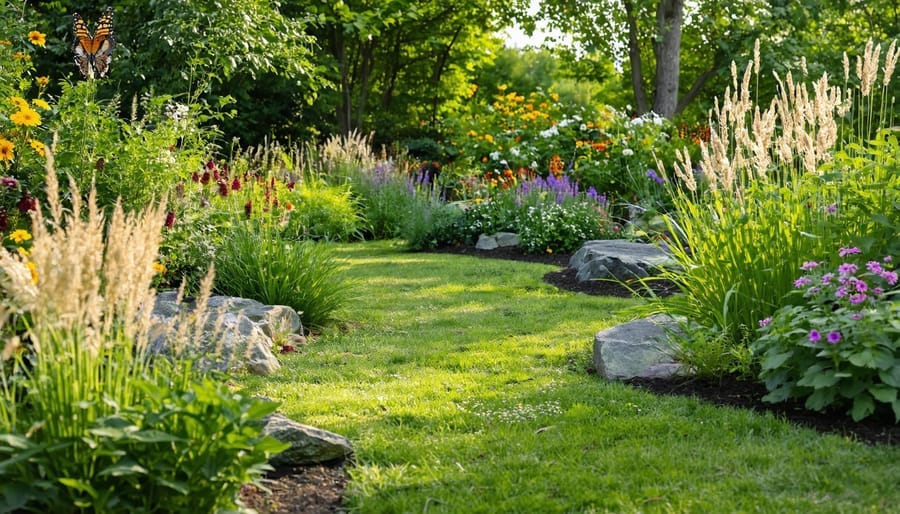
🌿 The Power of Native Plants (And Why They Matter More Than Ever)
Native plants evolved for millennia within a specific region’s climate, soil profile, insects, fungi, and weather patterns. Because of that, they offer benefits that ornamental imports or turf grass simply can’t:
1. They Bring Back Pollinators and Wildlife
Monarchs, bees, moths, beetles, birds, all of them rely on specific native species to complete their life cycles. Without natives, many can’t feed, nest, or reproduce.
2. They Dramatically Improve Soil Health
Native root systems are often 10–15 feet deep, compared to turf grass’s shallow 2–3 inches.
Those deep roots:
Break up compacted soil
Pull carbon underground
Reduce erosion
Increase water infiltration and retention
This makes entire neighborhoods more resilient to flooding and drought.
3. They Are Far Less Resource-Intensive
Native plants don’t need:
Regular watering
Fertilizers
Herbicides
Pesticides
In other words: they cost less money and cause less environmental damage.
4. They Reduce Urban Heat
Convert a street’s lawns into native meadows, and you’ll feel the temperature drop.
Native shrubs and groundcover break up heat-absorbing surfaces and restore natural cooling.
5. They Stitch Together Fragmented Landscapes
A single yard might not seem like much, but hundreds of yards create corridors.
Corridors become networks.
Networks support ecosystems.
🌎 If Just 10% of Yards Converted, the Landscape Would Shift
Researchers have shown that if even a small percentage of residential landscapes convert to native species, biodiversity increases at a landscape scale.
This is the crucial point:
Individual actions matter because they aggregate.
A single yard is a message.
A neighborhood is a signal.
A watershed is a transformation.
But here’s the challenge:
Despite the evidence, adoption is slow.
People like lawns because they’re familiar, normalized, and require little thought.
Many HOAs still enforce turf grass.
Local governments rarely incentivize alternatives.
And people who want to plant native species don’t always know where to begin.
So the real question becomes:
🌱 How Do We Create Incentives That Make Rewilding the Default, Not the Exception?
Here are several strategies communities, cities, and policymakers could implement, many already piloted in pockets around the U.S., Canada, and Europe.
1. Tax Credits or Rebates for Native Landscapes
We subsidize solar panels.
We subsidize energy efficiency.
Why not subsidize ecological restoration at the parcel level?
A $200–$500 rebate could dramatically increase adoption.
2. “Starter Kits” of Native Plants
Cities could partner with local nurseries to give every household:
A pollinator-friendly starter pack
3–5 region-specific perennials
A short guide on maintenance
Some cities already do this, and participation skyrockets.
3. HOA Reform
HOAs often enforce outdated aesthetic norms.
State-level legislation could:
Prohibit bans on native lawns
Protect “pollinator meadows”
Require HOAs to allow environmentally sustainable landscaping
Maryland and Minnesota have passed versions of this. More states could follow.
4. City Recognition Programs (“Certified Habitat Neighborhoods”)
Imagine a street sign that reads:
“This neighborhood supports pollinators.”
Recognition builds pride.
Pride builds participation.
Participation builds momentum.
5. Eliminate Barriers: Simplify Permitting and Update Codes
Some cities treat native yards as “overgrown” and fine homeowners.
Rewriting municipal codes to reflect ecological reality is essential.
6. Public Awareness Campaigns
Many people simply don’t know the benefits.
A simple campaign like:
“Plant Native. Heal the Neighborhood.”
could shift public perception.
7. Organized Community Events
Workshops, native swaps, seed-sharing, community demonstrations, all of these lower the barrier of entry.
🌼 This Is Suburbia’s Quiet Revolution
Native plants aren’t just about flowers.
They’re about:
ecological recovery
climate resilience
public health
soil restoration
beauty
community identity
giving people back a role in healing the place they live
Rewilding the yard is one of the most approachable, scalable, and democratic forms of climate action we have.
And the moment it becomes the norm, not the niche, is the moment our neighborhoods start to breathe again.
💬 A Question for You
What incentive do you think would motivate the most people to plant native species?
Tax credits? HOA reforms? City programs? Education? Social recognition? Something else?
I’d love to hear your thoughts.
If you’re interested in conversations about ecological citizenship, sustainable suburbs, and community-driven climate action, you’re welcome to join us on r/planetism_movement - a space for imagining what a just, livable future could look like and building it together.